
How the Chilli Reached India: From Mexican Fields to Indian Kitchens
The chilli is an American plant: Capsicum annuum, now the world's most widely grown spice crop, was domesticated in central-east Mexico, and it reached India by sea after the Portuguese opened their route around Africa. The popular story puts it in Goa early in the 16th century, but the first clear Indian description comes from the Malabar coast in the late 17th century. India is now the largest producer, consumer and exporter of chilli, with its own landraces such as bhut jolokia, Guntur Sannam and Byadagi. Those heritage types last only as long as gardeners and farmers keep their seed pure.
On this page
Where chillies were first domesticated
Chillies were domesticated more than once, in different parts of the Americas, and the five domesticated species did not share a single birthplace.
Mexico: Capsicum annuum
A 2014 study led from the University of California, Davis combined linguistics, ecological modelling of wild relatives, genetics and archaeology. Together they placed the domestication of Capsicum annuum in central-east Mexico, a region running from southern Puebla and northern Oaxaca to southeastern Veracruz. Cayenne, bell and bird's eye peppers all belong to this American genus.
South America and the Andes
The oldest chilli starch grains, from two sites in south-western Ecuador, are about 6,100 years old. In Panama chillies appear with maize and yams about 5,600 years ago, and a site in the Peruvian Andes occupied about 4,000 years ago held remains of Capsicum pubescens, the rocoto that is still eaten in Peru.
The three species that matter in India
Three of these species run through India's chilli story. Capsicum annuum and Capsicum frutescens are the two chillies recorded on the Malabar coast in the 17th century; Capsicum chinense includes the habaneros and, by plant and fruit characters, bhut jolokia.
Why a Mexican fruit was called pepper
Almost every early name ties the chilli to black pepper. Columbus thought the fruit resembled Piper nigrum; the plants are not closely related, but the name stuck. The word chilli itself is Nahuatl: a Nahuatl-Spanish dictionary of 1571 glosses it as "Chilli. Axi. o pimienta de las indias", axi being the Taino word for the same fruit. In 1542 the German botanist Fuchs called chillies Calicut pepper and Indian pepper, after the port on India's west coast, a label then used loosely for anything exotic. In India the Malabar flora Hortus Malabaricus illustrated two chillies under the local names Capo-molago and Vallia-Capo-Molago, and Linnaeus later cited those entries for Capsicum annuum and Capsicum frutescens. In Assam, the word jolokia simply means the Capsicum pepper.
The Portuguese route, and what the records prove
The Portuguese reached India by sea in 1498, and many accounts say their ships brought chillies around 1542, sometimes as "Pernambuco pepper", after a Brazilian region. Michael Krondl, in a paper for the Oxford Symposium on Food and Cookery, went back to the 16th-century botanical books and found that the Pernambuco story traces to a 1908 source citing the botanist Clusius, on a page that mentions neither Pernambuco nor Goa. Garcia da Orta and Cristóbal Acosta, who wrote about Indian and Asian plants and goods in the 1560s and 1570s, do not mention chillies at all. A 16th-century Kannada song by Purandaradasa, praising a fruit seen green and then red, too hot in excess, is often quoted as the first Indian chilli poem; but black pepper also ripens from green to red, and the poet's work was written down only in the 19th century.
The first firm evidence
The first unambiguous description in an Indian setting is Hendrik van Rheede's Hortus Malabaricus, a 12-volume flora of the Malabar coast published in Amsterdam between 1678 and 1693. By the 17th century chillies were clearly grown in South Asia; how they got there in the 16th century is still, in Krondl's word, a cipher.
A likely route
Krondl's working hypothesis runs through Atlantic trade nodes: American crops moved from Brazil to the Cape Verde Islands and São Tomé, then to the African mainland, and from there into Portuguese shipping towards Asia.
How fast the chilli spread
Once moving, the chilli travelled fast through Africa and Asia and slowly in Europe. Written records place it in China's interior by 1592. Europeans long treated it as a curiosity or an ornamental. By the 17th century it was a South Asian crop. Today India leads world chilli production and exports, Andhra Pradesh tops dry chilli production among Indian states, and the Guntur chilli yard is described by Andhra Pradesh's agricultural university as the largest chilli market in Asia.
The Indian landraces that followed
Local selection produced chillies that now carry legal protection as Geographical Indications. The Spices Board's register lists at least 16 chilli GIs, from Nagaland and Manipur to Goa, Kerala and Tamil Nadu.
Bhut jolokia (Northeast India)
A chilli from Assam that New Mexico State University tested in 2007. Its fruits are 5 to 8 cm long, wrinkled, and ripen from green to bright red. By plant and fruit characters it is a Capsicum chinense cultivar, with possible genetic input from Capsicum frutescens. In a replicated trial it averaged about 1,001,304 Scoville heat units, against about 357,729 for orange habanero, and Guinness World Records recognised it as the hottest chilli at the time. Nagaland holds the GI for Naga Mircha.
Guntur Sannam (Andhra Pradesh)
Registered as a GI in 2010 by the Spices Board for Andhra Pradesh.
Byadagi (Karnataka)
Registered as a GI in 2011 by the Spices Board for Karnataka.
Khola (Goa)
A Goan chilli registered as a GI in 2019, a living link to the coast where the Portuguese story begins.
Why saving open-pollinated seed keeps heritage chillies alive
A landrace survives only if its seed comes back true, and chillies cross more readily than many gardeners expect. Pepper flowers are perfect and readily self-pollinate, but bees and other insects carry pollen between plants, and different varieties of the same species cross easily. Some peppers of different species can cross too. Seed saved from an F1 hybrid will not give uniform plants, so only open-pollinated varieties can be kept this way.
Isolation distance
Guidance varies with how many pollinators are about. A University of California pepper seed guide suggests at least 400 feet (about 120 m) between varieties; University of Illinois Extension gives 300 to 1,600 feet (91 to 488 m); commercial seed growers usually need a quarter of a mile (about 400 m) or more.
Bags and cages
In a small garden, cover a flower bud with a small bag of breathable fabric such as row cover and leave it until the flower has self-pollinated; plastic bags and paper envelopes should not be used. Insect-proof cages over whole plants do the same job. New Mexico State University grew its bhut jolokia under insect-proof cages for three years to raise enough pure seed for the trial.
Enough plants
Seed specialists recommend at least 50 plants to maintain a variety's diversity, although small growers often use 5 to 20.
Ripe fruit and gentle drying
Take seed only from fully coloured, mature fruit; most seed from unripe fruit is not viable. Dry it below 35 °C (95 °F), test by bending (a dry seed snaps), and store it cool, dry and dark in a glass jar. Correctly stored vegetable seed generally keeps for at least 3 to 5 years.
Conclusion
The chilli's road to India ran from central-east Mexico through Portuguese trade, but the documents become certain only in the late 17th century, with the Malabar flora that recorded Capo-molago. India then turned an American fruit into its own landraces, from bhut jolokia in the Northeast to Byadagi and Guntur Sannam in the south, each an open-pollinated line that depends on clean seed. To keep one going, grow open-pollinated plants, separate or bag them, and save from many plants and ripe fruit only.
Grow a piece of chilli history
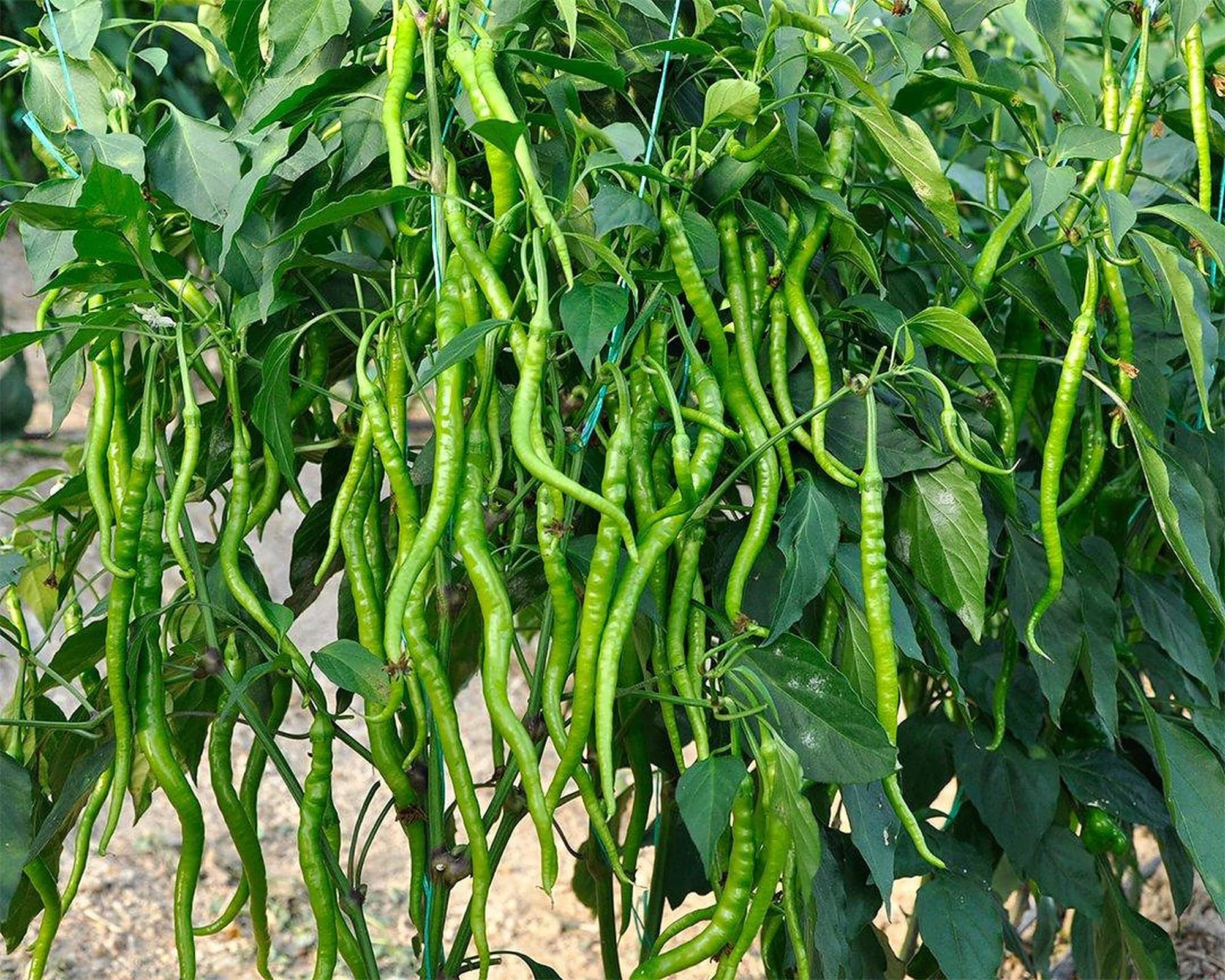
Start with open-pollinated chillies from the three species that shaped Indian cooking, from long green Capsicum annuum and Surajmukhi to the habaneros that share bhut jolokia's species, and save your own seed so the line keeps going.
Frequently asked questions
Did the Portuguese really bring chilli to India through Goa?
Portuguese sea trade is the most likely route, and many accounts date it to the 16th century. The direct evidence is weak: the clear Indian record starts with Hortus Malabaricus, published from 1678, and the Goa "Pernambuco pepper" story has no 16th-century source.
Is bhut jolokia the same species as habanero?
Botanists classify both as Capsicum chinense. The 2007 study of bhut jolokia found characters of that species, with possible genetic input from Capsicum frutescens.
How far apart should I plant chillies if I want to save seed?
Extension guides suggest roughly 120 to 490 m (400 to 1,600 feet) between varieties. In a small garden, bag flower buds or cage plants instead.
Can I save seed from a hybrid chilli?
You can sow it, but the plants will not be uniform or true to the parent. Save seed only from open-pollinated chillies.