 Shop at deodar-seeds.com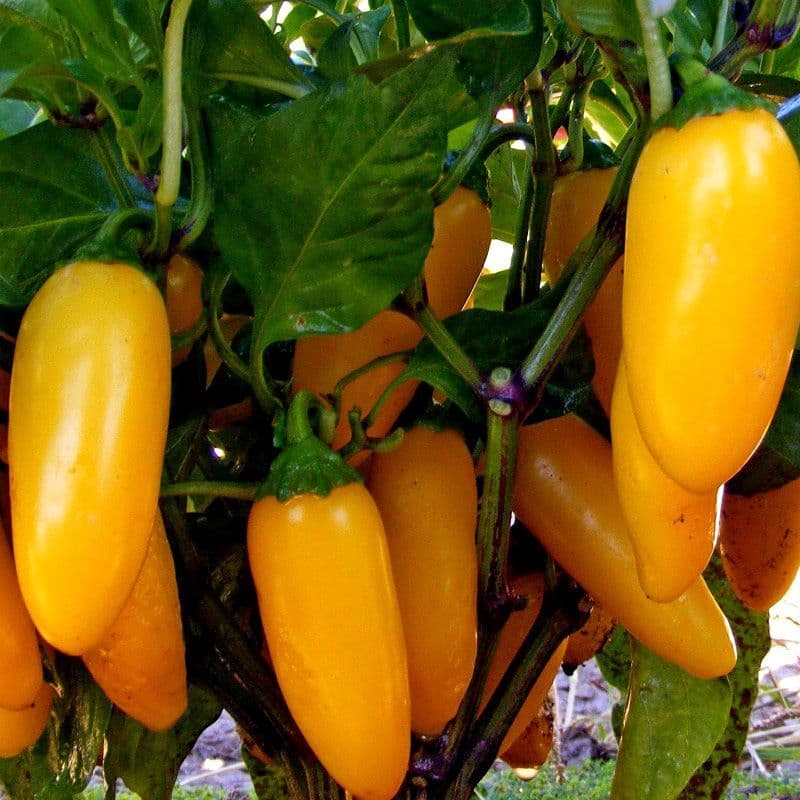
About this seed
NuMex Lemon is a jalapeño (Capsicum annuum, family Solanaceae) whose fruit ripens lemon-yellow instead of red and runs hotter than a standard jalapeño, at 25,000–30,000 Scoville heat units. The packet holds 5 seeds.
Also known as: Jalapeño, Chile jalapeño (Spanish, Mexico), Jalapeño (French), Peperoncino jalapeño (Italian), Mirchi (Hindi), Milagai (Tamil), Mulaku (Malayalam), Chile (Spanish), Piment (French), Peperoncino (Italian), Pimenta (Portuguese), Chili (German), Prik (Thai).
This jalapeño is credited to the Chile Pepper Institute at New Mexico State University.
Fruit and plant
- Fruit about 6.5 cm long and 2.5 cm across, thick-walled, smooth and glossy
- Ripens from green to bright lemon-yellow
- Compact plants about 60 cm tall, suited to beds or containers
- Used fresh in salsas, pickled or grilled
Sow into soil at 18–35 °C
Start the seed indoors 6–8 weeks before the last frost. Seedlings appear in about 8–9 days when the soil is 25–35 °C; 18–35 °C is the soil range that suits pepper germination, so keep the tray inside it until the first leaves show. Cover the seed with about 6 mm of seed-starting mix.
These figures are typical for the species (emergence was measured with seed about 13 mm deep); they are not a test of this packet.
Planting out
Transplant once the soil is warmer than 20 °C. Space plants 45–60 cm apart with 60–90 cm between rows, in full sun and fertile, well-drained soil at pH 5.5–7.5. Keep the soil moist without waterlogging. Feed with a nitrogen-rich fertiliser early, then switch to a potassium-rich one at flowering.
When to expect fruit
Fruit matures about 65 days after transplanting, counted from the day the plant goes outside.
What you get: 5 seeds per packet. Pepper seed usually stays usable for about 2 years when kept cool, dark and dry, so you can sow part of the packet and keep the rest. That is a general figure for the species; we do not state a germination percentage for this packet.
FAQ
Will it grow in a pot?
Yes. At about 60 cm the plant stays compact enough for a container in full sun.
How does it differ from a common jalapeño?
The fruit turns lemon-yellow rather than red when ripe, and at 25,000–30,000 Scoville heat units it is hotter than traditional jalapeños.