Seed preparation
Use raw, unroasted almonds; blanched or roasted nuts will not grow. In the Spanish trial (García-Gusano and colleagues, CIHEAM), nuts were dipped in fungicide and then soaked in water for 48 hours before chilling.
Nut tree growing guide
Almond seed sprouts well once it has had a cold, moist rest of several weeks, and a seedling makes a hardy tree or a rootstock for grafting. This guide covers stratification, sowing, the climate almonds need and why seedling nuts can differ from the parent.
Use raw, unroasted almonds; blanched or roasted nuts will not grow. In the Spanish trial (García-Gusano and colleagues, CIHEAM), nuts were dipped in fungicide and then soaked in water for 48 hours before chilling.
Optional but effective. Cracking off the hard shell (endocarp) and peeling the brown seed coat had an effect similar to chilling in the Spanish trial. In Egypt, shelled seed sown on 20 December gave 71% germination against 33% for seed in its shell.
Needed for seed in its shell. Keep soaked nuts in moist vermiculite or sand in a bag at 2-7 °C (36-45 °F), for example in a refrigerator. In the Spanish trial, 15 weeks at 7 °C (45 °F) gave 87-98% germination depending on variety; 4 weeks was not enough for all varieties. Heat alone does not break dormancy.
Yes: soak 48 hours before stratifying, as in the Spanish trial.
The chill does the work: 2-7 °C (36-45 °F) is generally most efficient, and an older study found 3 weeks at 10 °C (50 °F) equal to 5 weeks at 2 °C (36 °F). Avoid warm spells above about 17 °C (63 °F) during chilling. After chilling, seeds grow on at normal room or spring temperatures; the Spanish trial used 22 °C (72 °F).
About three times the size of the seed, one seed per bag, as in the Egyptian nursery trial. Sow sprouted seeds carefully so the root is not snapped.
Moist vermiculite or sand for chilling; a free-draining potting mix in deep pots for growing on.
Moist but not wet during chilling; check weekly for mould and sprouting.
No light needed during chilling. Move seedlings into full sun once leaves open.
Radicles appeared from week 5-6 of chilling at 7 °C (45 °F), and most seed had sprouted by week 15. Pot each seed as soon as its root shows.
Plant out in full sun for at least three-quarters of the day, in well-drained soil, allowing a radius of about 3-3.7 m (10-12 ft) for a mature tree. New trees need about 11-19 litres (3-5 US gallons) per watering for the first few weeks.
Train a straight trunk with no branches for 76-102 cm (30-40 in), topped by a whorl of scaffold branches. If the young tree is unbranched, cut it at 76-91 cm (30-36 in) above the soil.
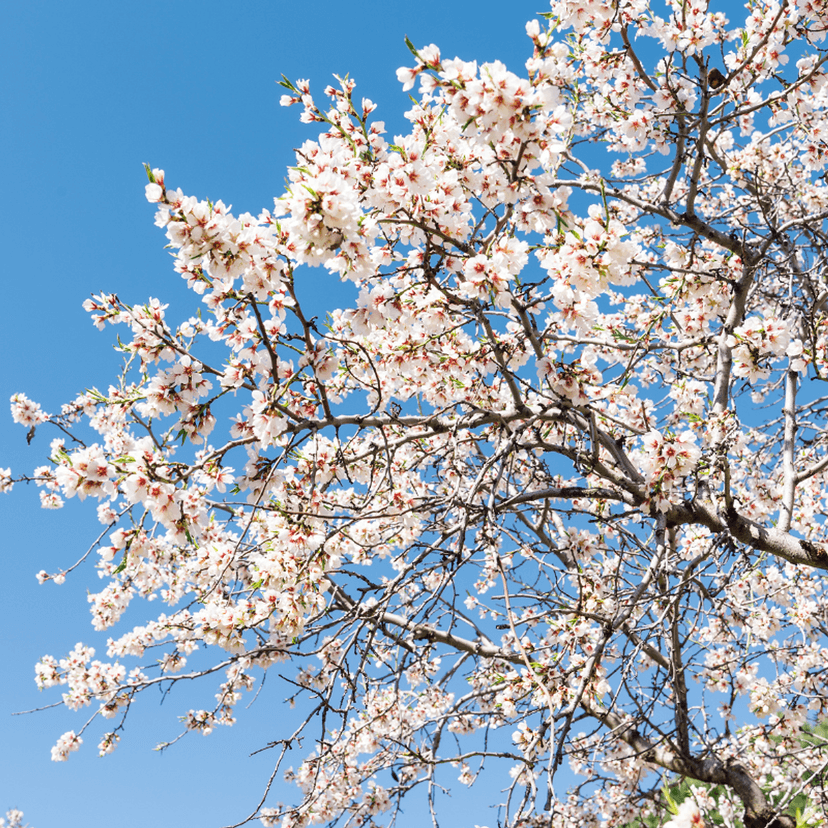
Almond is a temperate tree whose flowers are damaged by frost below -2 °C (28 °F), so late frosts matter more than winter cold. In India it is grown mainly in northern Jammu and Kashmir and the high hills of Himachal Pradesh; it is not a crop for the hot plains.
Most named almonds are grafted. A strong seedling can be grafted with a proven variety; ICAR scientists name Waris, Pranyaj and Nonpareil as promising cultivars for Indian growing areas.
Wet the soil to about 30 cm (1 ft), then let it dry for several days before the next watering.
Give about 28 g (1 oz) of actual nitrogen per tree per year of age, up to 227 g (1/2 lb) per tree per year.
Stratify almond seed over winter for strong seedlings and rootstocks in spring.
Yes, seed in its shell is dormant. Several weeks of moist chilling at 2-7 °C (36-45 °F) breaks dormancy; in one trial 15 weeks at 7 °C gave 87-98% germination. Removing the shell and seed coat works as an alternative.
Not necessarily. Seedlings vary, and some inherit bitter kernels. Taste carefully, discard bitter nuts, and graft a named sweet variety for reliable crops.
Almonds are temperate trees. In India they crop mainly in the cooler hills of Jammu and Kashmir and Himachal Pradesh, not in the hot plains.
Utah State University advises a first harvest 4-6 years after planting a tree; seedlings are often slower and less productive.