Free EMS courier delivery across India
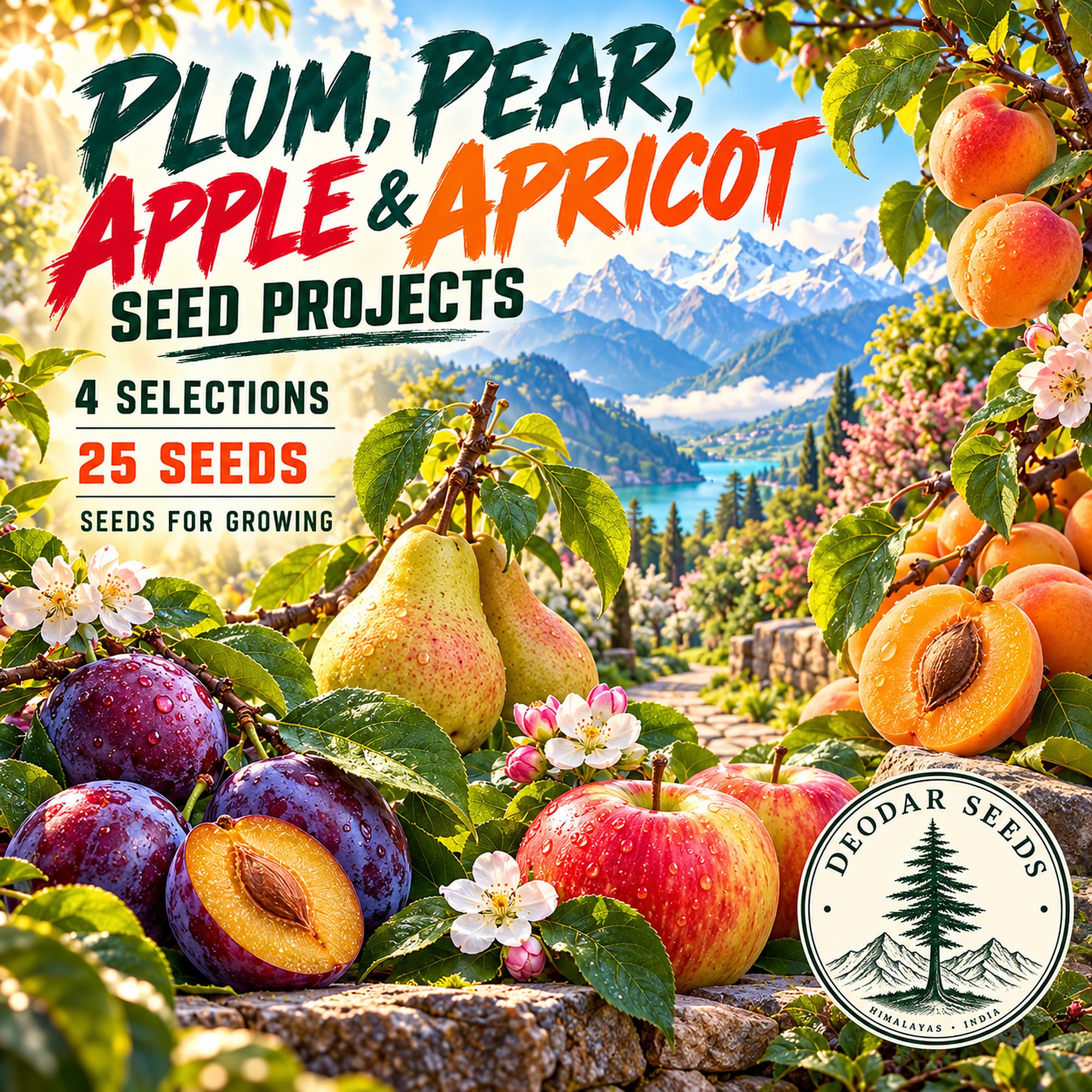
Plum, Pear, Apple & Apricot Seed Projects — 4 Seed Selections plant

Fruit tree growing guide

How to grow pear trees from seedPyrus communis

Pear seed needs about three months of moist cold before it will germinate, and seedlings do not come true to the parent fruit. Grow them as rootstocks or as an experiment, and graft a named variety for reliable pears.

≈ 20 °C
Germination temp.
5-30 days
Germination
≈ 8 mm
Sowing depth

At a glance

Germination temperature
About 20 °C (68 °F) after cold stratification.
Sowing depth
Shallow: cover the seed with about its own thickness of compost or sand. The seed is about 8 mm long.
Germination time
5-30 days at about 20 °C, once stratified.
Light
No light is needed under a thin cover. Grow seedlings in full sun.
Pre-treatment
Wash, soak for one day, then keep moist and cold at about 4 °C (39 °F) for about 90 days.
Transplant or direct sow
Sow in pots or nursery rows and transplant the young trees.

Seed preparation

Seed preparation

Use plump, dark seeds from ripe fruit. Take them out of the fruit and wash off all the pulp. In one study, seeds left inside the fruit through the cold period germinated poorly (about 7%), compared with about 85% for extracted seeds.

Scarification

Not needed. Dormancy is in the embryo, so cold treatment is what wakes the seed. Researchers sometimes peel the seed coat, but home growers do not need to.

Stratification

Essential. Seeds from fresh fruit have dormant embryos. Mix them with damp sand or wrap them in moist paper in a bag, and keep them at about 4 °C (39 °F) for about 90 days. In a study of Asian pear (P. pyrifolia), germination rose with longer cold and peaked at 100 days. In India, kainth rootstock seed is stratified in moist sand at 2-5 °C for 35-45 days.

Soaking

Soak the cleaned seed in water for one day before stratification.

Plum, Pear, Apple & Apricot Seed Projects — 4 Seed Selections

Germination conditions

Germination temperature

After stratification, germinate at about 20 °C (68 °F). Seeds kept warm (25 °C) without any cold treatment did not germinate at all in the P. pyrifolia study.

Sowing depth

Cover the seed thinly, with about its own thickness of compost or sand. Seeds that have started to sprout in the stratification bag can be potted individually with the root pointing down.

Growing medium

A free-draining seed compost, or a mix of loam and sand, in deep pots or nursery rows.

Moisture

Keep the stratification mix damp but not wet, and check it every couple of weeks for mould and early sprouting. After sowing, keep the compost evenly moist.

Light

No light is needed for germination. Move seedlings into good light as soon as they emerge.

Germination time

Usually 5-30 days at about 20 °C after a full cold period. Seed that has had too little cold germinates slowly and unevenly.

Transplanting and first growth

  1. Transplanting

    Pot each seedling on before its roots circle the pot. ICRAF gives a planting-out height of about 65-75 cm. Plant out in a sunny, sheltered spot away from frost pockets.

  2. First growth stage

    In India, one-year-old kainth (Pyrus pashia) or shiara (P. serotina) seedlings are used as rootstocks for budding or grafting. A pear seedling can be used the same way: graft a named variety onto it for fruit you can rely on.

Plum, Pear, Apple & Apricot Seed Projects — 4 Seed Selections

Common problems

ProblemNo germination
Cause
The seed was not given enough cold, or it dried out.
What to do
Stratify extracted, washed seed for about 90 days at about 4 °C in a damp medium, then sow at about 20 °C.
ProblemSeedling fruit is small or poor
Cause
Seedlings are genetically new trees and do not copy the parent.
What to do
Graft a named variety onto the seedling, or treat it as a rootstock.
ProblemFlowers fail to set fruit
Cause
Spring frost (open blossom is killed at 3.3 °C or below), or no compatible pollinator nearby.
What to do
Avoid frost-prone sites, cover small trees with fleece on frosty nights, and plant a compatible variety that flowers at the same time.
ProblemShoot tips blacken as if scorched
Cause
Fire blight, a bacterial disease.
What to do
Cut out blighted twigs and cankers in the dormant season, and avoid excess nitrogen and heavy pruning.
ProblemBright orange leaf spots or sticky leaves
Cause
Pear rust (which also lives on junipers), or pear psylla producing honeydew.
What to do
Do not grow pears right next to junipers; against psylla, keep nitrogen moderate and summer-prune to open the canopy.

Practical growing tips

Match the climate

In India, pears grow from the foothills to the high hills at about 600-2700 m and need roughly 500-1500 chilling hours. The Kisan guide lists Bartlett, Red Bartlett, Flemish Beauty, Conference and Clapp's Favourite for high hills, and Patharnakh, Kieffer, Punjab Beauty and Punjab Gold for mid and low hills and valleys.

Plan for pollination

Most pears need a second compatible variety that flowers at the same time. Self-fertile varieties are the exception.

Choose size with the rootstock

Pears on their own roots, including seedlings, reach 6 m (20 ft) or more. Grafting onto quince rootstocks gives a 2.5-4.5 m (8-15 ft) tree in temperate gardens.

Water through dry spells

A lack of water in summer makes extra fruitlets drop. Water deeply during dry weather while the fruit is setting.

Pick early, ripen indoors

Harvest firm fruit when it lifts with a twist. Store it cool and dark, not touching, and check it regularly while it ripens.

Pear seeds from Deodar

Stratify pear seed for about three months, then raise seedlings as rootstocks or as your own pear experiment.

Frequently asked questions

Will a tree grown from a pear seed give the same pears?

No. Pears cross-pollinate, so each seedling is a new tree with different fruit. Named varieties are grafted.

How long do pear seeds need in the fridge?

About 90 days at around 4 °C in a damp medium. For Asian pear, about 100 days worked best in one study.

Can I grow pears in India?

Yes, in the hills. The Kisan guide gives about 600-2700 m and 500-1500 chilling hours, with lower-chill varieties such as Patharnakh listed for mid and low hills and valleys.

How long until a seedling pear fruits?

Longer than a grafted tree, which bears in about 2-5 years depending on the rootstock. Grafting a named variety onto the seedling is the faster route.